
Coaching Versus VOD Analysis: What Works?
Coaching versus VOD analysis: compare live feedback, replay review, cost, and practice structure to choose the right path for your ranked climb faster.
In this article5 sections
You lose a close Valorant round because you rotate late. In League, you give up a wave to contest an objective that was already gone. You know something went wrong, but that is not the same as knowing why it happened or what to do next match. That is where the coaching versus VOD analysis decision matters.
Both can improve your ranked play. Both can expose bad habits that are hard to notice while you are focused on mechanics, comms, and the next fight. But they solve different problems. One gives you direct, interactive guidance. The other gives you a detailed look at decisions you have already made.
The right choice depends on whether you need answers, accountability, real-time correction, or a clearer picture of your own patterns.
What coaching gives you that a replay cannot
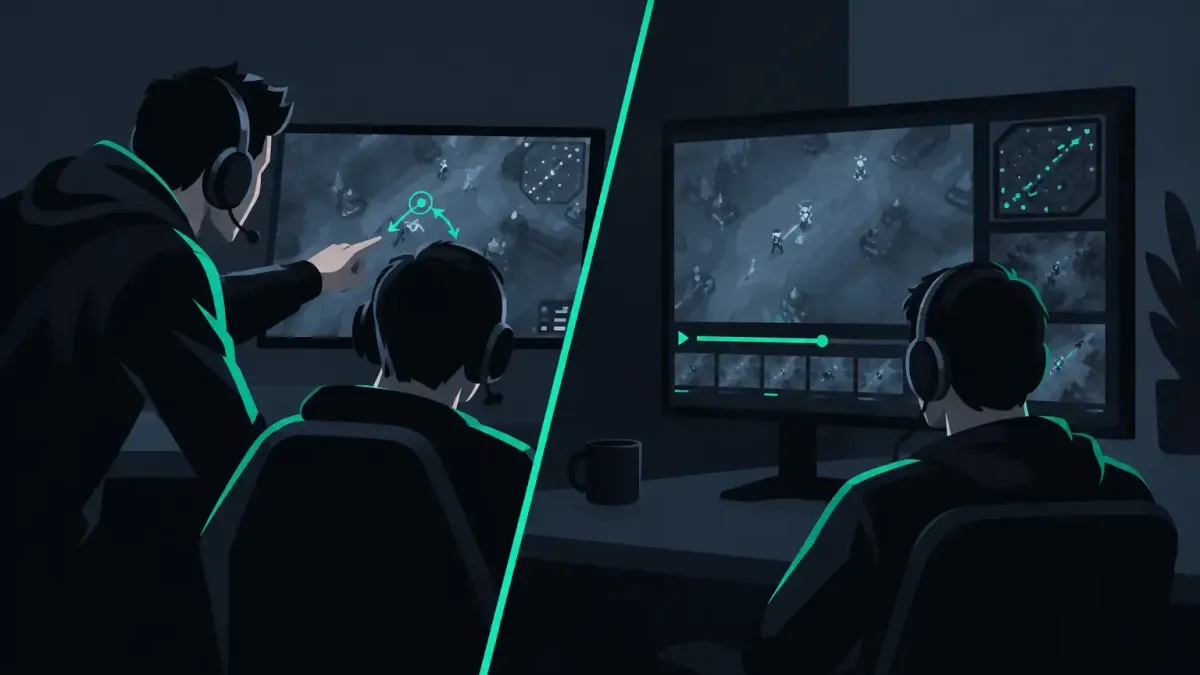
Coaching is a live conversation built around your gameplay and goals. A coach can watch you play, review a match with you, answer questions, and adjust the session when a problem appears. If you are stuck on a specific issue, that back-and-forth is the main advantage.
Say you are a CS2 player who keeps losing opening duels. A VOD can show poor crosshair placement, repeated peeks, or bad timing. A coach can go further. They can ask what information you had, explain why a position was weak, show a better route, and check whether you understand the adjustment before moving on.
That matters when the problem is not just one bad decision. Many players know the basic advice already. They know they should avoid fighting down numbers, track cooldowns, or stop queueing after a rough streak. The difficult part is applying those ideas under pressure. Live coaching can turn general advice into rules you can use in your next game.
Coaching is also useful when your goals need structure. You may want to improve your lane phase in League, your retakes in Valorant, your rotations in Apex, or your economy decisions in CS2. A good session can narrow that broad goal into a small practice plan instead of giving you ten things to fix at once.
Coaching works best when you can participate
A coaching session is not passive entertainment. You get more from it when you bring recent matches, ask direct questions, and are willing to hear that your favorite play was not actually the right one.
It is especially effective for players who are unsure where to start. If every loss feels different, a coach can identify the repeated mistake underneath them. It may be poor map awareness, weak trading discipline, autopilot farming, panic utility, or simply taking fights without a clear win condition.
The trade-off is that coaching asks more of you. You need time to attend, focus, take notes, and practice after the session. One strong session can give you direction, but it will not replace the games required to build consistency.
Where VOD analysis is stronger
VOD analysis is a focused review of recorded gameplay. It slows the game down and makes your decisions visible. That is valuable because ranked matches move too fast for honest self-review in the moment.
A replay review can pause before a team fight and ask the questions that decide the fight: What information did you have? What cooldowns were missing? Did you need to be there? Was the objective worth contesting? Did your position give you an exit?
For players with a clear problem, VOD analysis can be the most efficient option. Maybe you are already comfortable with your mechanics but keep throwing leads. Maybe your aim feels fine, but your deaths happen in the same parts of every map. A good review can find those patterns quickly.
It also gives you evidence. Ranked players often blame teammates, matchmaking, or one unlucky fight because those moments stand out. Reviewing the VOD can show a more useful truth: you took three low-value fights before the loss, missed a timing window, or failed to reset after getting an advantage.
The best VODs are not always your best games
Do not only submit a match where you popped off. A close loss, an ugly loss, or a game where you felt lost is often more useful. Those matches reveal decision-making when the game stops following your preferred plan.
Choose a VOD that matches your goal. If you want help with early-game pressure, send a game where lane or the opening rounds went badly. If you want better late-game calls, send a match that reached the point where you usually lose control. Context makes the feedback more practical.
The limitation is that VOD analysis can become one-sided if you do not have a chance to ask follow-up questions. Written or recorded feedback may tell you what happened, but some players need a live explanation before the lesson clicks. A replay also cannot test whether you can make the correction in real time.
Coaching versus VOD analysis: choose by your problem
If you need someone to identify the biggest issue in your play and give you a clear routine, coaching is usually the better starting point. The live format helps when you have many questions, feel stuck, or need feedback tailored to your decision-making.
If you have a specific match, map, role, or mistake pattern you want examined, VOD analysis is often the cleaner choice. It is direct. You provide the evidence, and the review stays centered on what actually happened rather than what you remember happening.
For many players, the strongest setup is both, in order. Start with a VOD review to identify the recurring errors. Then use coaching to test the fixes, ask questions, and build habits around them. You do not need to buy both at the same time. The point is to avoid paying for broad advice when you need a precise answer, or paying for a replay breakdown when your real issue is execution.
Reward boxes
Open a box, win real rewards
Spend N1 Coins to open a box and win coins, checkout discounts, or a free coaching/boost service.



Think about rank goals honestly
Coaching is for improvement, not a shortcut around practice. You still need to queue, make mistakes, and apply the feedback in real matches. If your goal is to become more independent at your rank, coaching and VOD review are the right tools because they focus on your own decisions.
Boosting serves a different purpose. Some players want rank progress because they do not have time to play the required games, while others want to improve enough to climb on their own. Do not confuse the outcomes. A higher rank does not automatically build better habits, and a coaching session does not promise a certain rank.
If you use any boosting service, remember that boosting is against most games' terms of service. No method is risk-free. If your priority is learning without sharing account access, coaching or VOD analysis is the more direct fit.
How to get value from either option
Before a session or review, set one main goal. “Help me get better” is too broad. “I die first too often on defense,” “I lose tempo after my first jungle clear,” or “I cannot convert a lead in TFT” gives the feedback somewhere to go.
Bring recent examples and be honest about your role in the loss. That does not mean every defeat is your fault. It means you are looking for the choices you can control. The useful question is not “Who threw?” It is “What could I repeat better in the next five games?”
Afterward, keep the practice plan small. Pick one or two changes and track them over several matches. For example, a Valorant player might focus on trading instead of taking isolated repeeks. A League player might track the enemy jungler before pushing a wave. Results may not show up in one match, but repeated decisions are what move your level over time.
N1Boost coaching can combine one-on-one feedback, VOD review, Discord Q&A, practice routines, and a climb plan. The useful part is not receiving more information. It is leaving with feedback you can actually use when the next ranked game gets messy.
The better option is the one that turns your next loss into a lesson instead of another queue where the same mistake happens again.
Ready to climb?
Pick a service, set your options and get matched with a verified booster. Secure checkout and 24/7 support.
- VPN and offline mode
- Verified boosters
- 24/7 support