

9 Best League Jungle Practice Drills for Ranked
Learn the best League jungle practice drills for cleaner clears, better lane reads, and smarter objective calls before you put LP on the line in ranked.
In this article3 sections
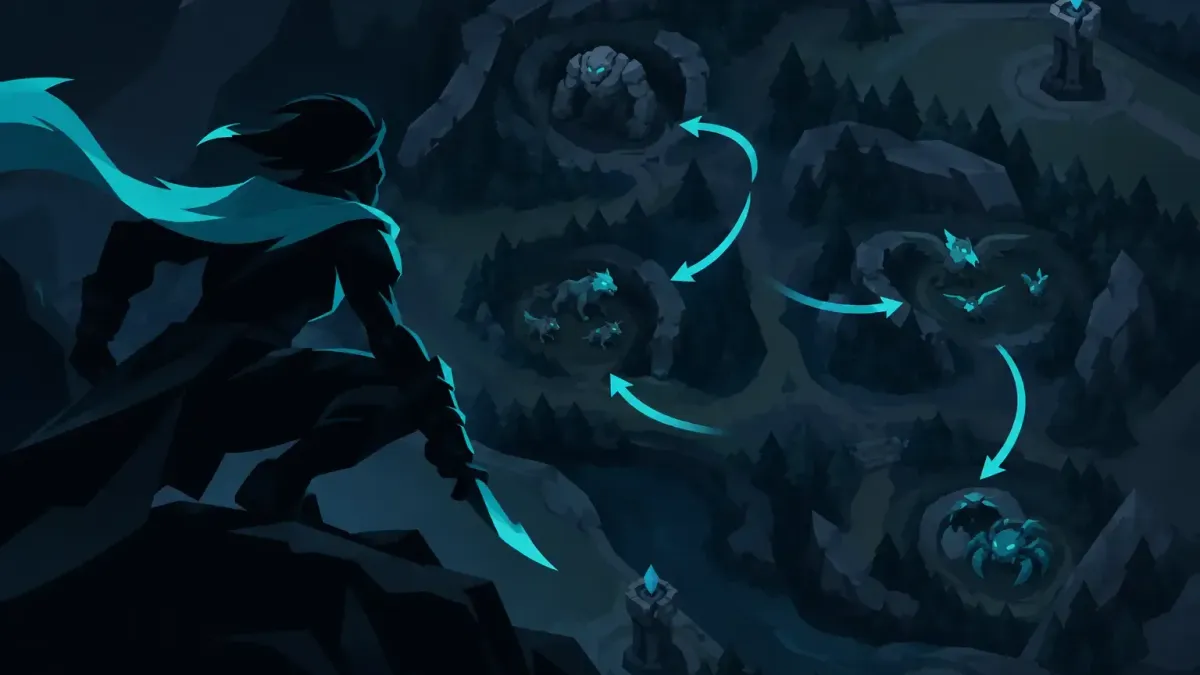
A jungle game can go wrong before either team has taken an objective. You lose a few seconds on your first clear, arrive late to a lane, and suddenly the enemy jungler gets the first play while you are still deciding where to go. The best League jungle practice drills fix those repeat mistakes without asking you to spam ranked games and hope experience sorts them out.
Good jungle practice is specific. Do not load into Practice Tool with the vague goal of getting better. Pick one skill, repeat it under a clear rule, then review whether it held up when the game became messy. Your goal is not a perfect highlight play. It is a cleaner decision pattern you can use when a lane is losing, camps are up, and an objective is about to spawn.
What Jungle Practice Should Actually Improve
Junglers need mechanics, but most lost tempo comes from planning. A clean clear matters because it determines your first lane timing. A useful ward matters because it tells you which side of the map you can play. A recall matters because buying at the wrong time can leave you unable to contest the next objective.
Practice Tool is great for repeatable execution: camp order, leashless clears, ability use, kiting, and Smite timing. Normal games and ranked games are better for the parts that need real opponents: reading lane states, predicting invades, and deciding when a gank is not worth the time.
Keep your champion pool narrow while you train. Drilling three comfort picks gives you patterns you can trust. Switching champions every game can be fun, but it makes it hard to tell whether a problem came from your route, your mechanics, or an unfamiliar kit.
Best League Jungle Practice Drills for Cleaner Tempo
1. Run the first clear with a single benchmark
Enter Practice Tool and do your planned first clear three times on the same champion. Use the same starting side and the same camp order. Write down your health, remaining potions if relevant, Smite charge, and the moment you are ready to make your first real decision: gank, invade, Scuttle, or recall.
The point is not to copy a route blindly. A full clear can be correct on a farming jungler, while a three-camp route may fit a champion with strong early ganks. What matters is knowing the cost. If you skip camps for a gank, know exactly what you give up and when you can recover the lost tempo.
Once you have a clean baseline, repeat the drill from the opposite side. Many players only practice their preferred start, then look clumsy when lane matchups force them to path differently.
2. Drill camp-to-camp movement, not just damage
A clear is not only about killing each camp quickly. It is also about how early you move toward the next one. Practice pulling camps toward your exit path while keeping them within their patience range. Use abilities in an order that helps you leave sooner rather than simply producing the biggest number on one target.
Watch for dead time. That includes standing still after a camp dies, walking through the middle of the map without a reason, or checking a lane so long that you miss your next camp timer. Small pauses are easy to ignore in one game and expensive over a full match.
This drill has a limit. Do not force perfect kiting in a real game if it makes you miss an obvious fight or walk into a dangerous river. Clean mechanics create options. They should not turn you into a player who ignores the map.
3. Practice Smite decisions at objectives
Set up an objective attempt in Practice Tool and repeat the final sequence: approach, place vision, pull the objective to a useful position, and secure it with Smite. Focus on the health range where your damage plus Smite will finish the target.
Then add a rule: do not use Smite early unless it speeds up a clear enough to change your next play. Holding it can protect an objective attempt. Spending it can protect your health and timing. There is no universal answer, which is why this drill should build awareness rather than a rigid habit.
In real games, also track enemy jungle position before starting an objective. A practiced Smite is valuable, but it does not fix starting a fight when your lanes cannot move first.
4. Use a 10-second lane-read check
Before every camp in a normal game, take a quick look at the two nearest lanes. Ask three questions: Which side is pushing? Who has crowd control or flash available? If I show here, can the enemy jungler punish the other side of the map?
Do not stare at lanes waiting for a perfect gank. Make the check fast, then continue your route if the setup is not there. This trains you to see opportunities without dropping your farm for low-percentage plays.
After the match, review the first two ganks you considered. You are looking for a simple answer: was the lane state actually good, or did you walk over because the ally pinged? A player asking for help is not automatically a playable lane.
5. Rehearse your response to an invade
In Practice Tool, plan your first route, then deliberately imagine the enemy jungler appears at your second buff or enters your side of the river. Say your response out loud before you move. Will you contest with lane priority, trade camps on the other side, take vision, or back away?
This may sound basic, but it stops panic pathing. When players get invaded, they often chase through fog, lose health, and then also lose the camps that were still available. Trading resources can be the better result when your nearby lanes cannot rotate.
In match review, check whether your early wards gave you enough warning. A ward has more value when it answers a timing question, not when it simply reveals an enemy after the invade has already happened.
6. Train objective setup one minute early
Pick the next major objective and set a one-minute rule. At that point, decide whether you need to reset, finish camps, place vision, or move to the opposite side because your team cannot contest. Repeat this in every game, even if the objective is likely to be traded.
The drill is about arriving with a plan. Many jungle players clear one extra camp, recall late, then reach the river after vision control and lane priority are already gone. Sometimes the extra camp is correct. It depends on your item timing, ally wave states, and where the enemy jungler last appeared. Make the choice early instead of drifting into it.
7. Practice reset discipline
After each meaningful play - a gank, invade, objective, or full clear - pause for two seconds and choose your next reset window. Spend gold when it improves your next contest or when your map side is empty. Do not remain on the map with low health and unspent gold just because a nearby camp is available.
To review this drill, find your first two recalls after the opening clear. Were they timed around a useful purchase and your next route? Or did you recall because you had no plan left? Better resets are one of the simplest ways to make your jungle path feel less rushed.
8. Play one game with a no-forced-gank rule
Queue a normal game and set one restriction: you may only gank when the lane state, your health, and the likely enemy response make sense. No walking into a pushed lane because you feel behind. No hovering for thirty seconds hoping an opponent misplays.
This drill feels passive at first, especially if you are used to trying to fix every lane. It teaches a useful ranked habit: your time is a resource. Take camps, track the enemy jungler, and play around lanes that can help convert a lead.
9. Review one decision, not the whole VOD
After a game, review one moment that changed your tempo. It could be a failed gank, an invade, a late recall, or an objective you gave up. Watch it once without excuses, then answer what information you had, what information you missed, and what your default response should be next time.
Avoid reviewing every death for an hour. That usually produces vague notes and no repeatable fix. One focused lesson carried into the next session is more useful than a long list of mistakes.
Turn Drills Into a Weekly Routine
A practical routine is three first-clear repetitions before you queue, followed by one normal game focused on a single decision skill. In ranked, keep the same focus but do not treat the match like a laboratory. Play to win, then take one note afterward.
If you keep reaching the same decision point and cannot tell what the correct play was, coaching can help. A good review should show where your route stopped matching lane states and give you a practice routine you can actually repeat. The goal is not to memorize someone else's path. It is to build a decision process that still works when the game gets unpredictable.
Your next game does not need a new jungle trick. Start with one clean clear, one early map read, and one reset made on purpose. Those habits create more winning opportunities than forcing the play that is not there.
Reward boxes
Open a box, win real rewards
Spend N1 Coins to open a box and win coins, checkout discounts, or a free coaching/boost service.
Ready to climb?
Pick a service, set your options and get matched with a verified booster. Secure checkout and 24/7 support.
- VPN and offline mode
- Verified boosters
- 24/7 support