
CS2 Premier Versus Ranked: Which Mode Fits You?
CS2 Premier versus ranked compares rating, maps, queues, and goals so you can pick the mode that fits your next Counter-Strike session for each week.
In this article7 sections
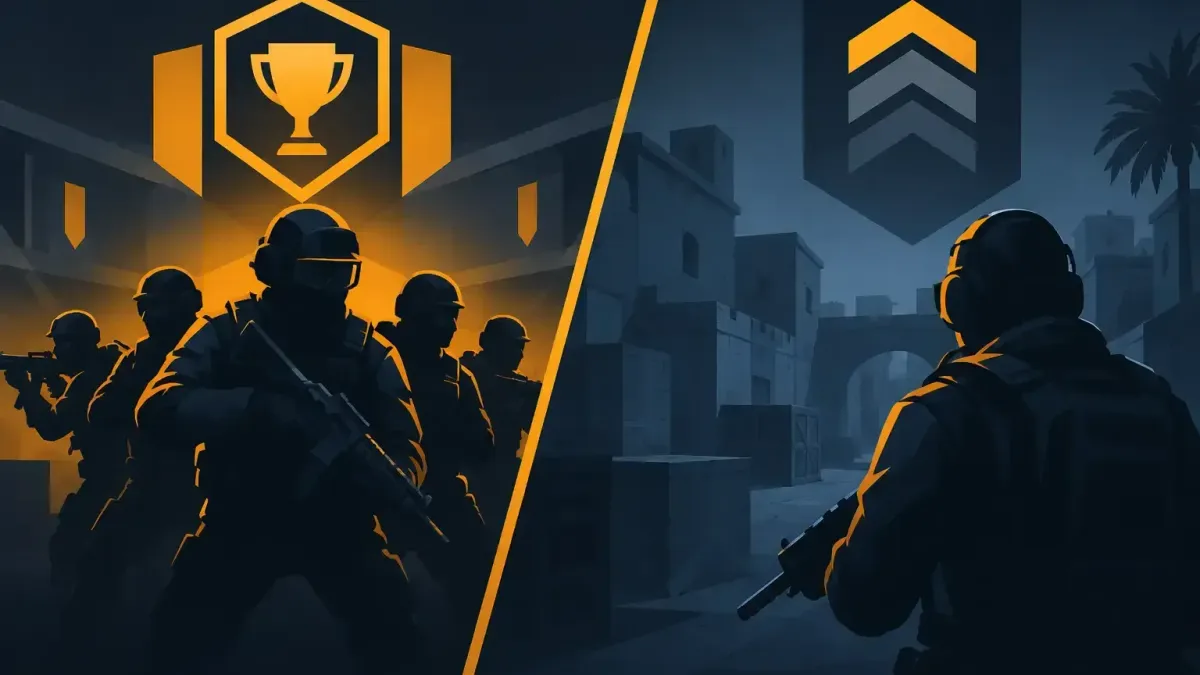
Premier versus ranked is not just a menu choice in Counter-Strike 2. The two modes measure progress differently, reward different habits, and can leave you with very different goals after a session. If you want one visible rating to chase, Premier is usually the clearer fit. If you care about building results on specific maps, Competitive ranked can make more sense.
What Premier Means in CS2
Premier is CS2's broader competitive queue. Your progress is represented by a CS Rating rather than a traditional rank badge. After finishing your placement matches, wins and losses move that rating up or down. The number gives you a straightforward way to judge where you stand and what you need to climb next.
A Premier match also starts with a map selection process. Teams remove maps before the final map is chosen. That changes the skill set required to climb. It is not enough to be comfortable on one map. You need a workable map pool, basic veto awareness, and the ability to communicate when your preferred pick is gone.
For players who enjoy the full competitive format, that is the point. Premier asks you to perform across the active pool, adjust to different teammates, and manage every match as part of one rating journey. It tends to feel closer to a single ladder, where every game has a visible effect on your number.
The downside is that a poor run can feel more personal because the rating is always in view. If you only know one or two maps well, the veto can also expose that quickly. Premier rewards consistency, but it does not hide weak spots in your map pool.
How Competitive Ranked Works
Competitive ranked uses a more map-focused approach. Your rank is tied to individual maps, so your result on one map does not automatically represent your standing everywhere else. This gives you more control over what you queue and where you build experience.
That structure is useful when you are learning. You can spend time on a map's callouts, common utility, rotations, and site setups without being forced into every map in the pool. A player who is reliable on Mirage but still learning Ancient can keep those two goals separate.
Competitive also suits shorter, more focused sessions. Instead of worrying about a veto and a broad pool, you choose the maps you want to practice. The trade-off is that your progress becomes fragmented. A strong rank on one map does not mean you can produce the same result on another.
This is why Competitive is often better for specialists and developing players, while Premier is better for players who want one number that reflects their overall queue performance. Neither mode is automatically harder. The better choice depends on what you are trying to improve or show.
Premier Versus Ranked: The Main Differences
The biggest difference is how each mode defines your standing. Premier gives you one CS Rating. Competitive gives you separate map ranks. That sounds simple, but it affects how you queue, what you practice, and what a rank-up means.
In Premier, a climb usually requires a wider game plan. You should be comfortable with map vetoes, have at least a few dependable maps, and understand how to contribute even when the match does not land on your strongest pick. A player who can call a basic plan, adapt mid-round, and keep composure through close games has more room to grow there.
In Competitive, the path is narrower by design. Pick a map, learn it well, and keep improving your results there. This can be more efficient if your aim is to build confidence, refine your utility, or play with friends who always prefer the same maps. It can also be less demanding when you do not have time to maintain a full map pool.
Match expectations differ too. Premier players often treat rating as the main outcome, so losses may bring more pressure and more discussion around team play. Competitive can still be serious, but the map-specific system makes it easier to treat a queue as targeted practice rather than a verdict on your entire skill level.
Reward boxes
Open a box, win real rewards
Spend N1 Coins to open a box and win coins, checkout discounts, or a free coaching/boost service.
Choose Premier If You Want a Clear Ladder Goal
Premier makes sense when you want a single rating that is easy to track. You may be trying to reach a personal milestone, compare progress from one week to the next, or test whether your overall game holds up across a wider set of maps.
It is also the better mode when you already have a stable foundation. You do not need perfect utility on every map, but you should know the common positions, basic economy decisions, and how to play your role when plans change. A good Premier player is not necessarily the best aimer in the lobby. They are often the player who creates fewer avoidable rounds for the other team.
If you want to climb Premier, review the losses that feel repetitive. Are you losing early map control? Are your buy rounds out of sync? Are you entering sites without trade potential? A rating only tells you the result. Your demos and match habits explain why that result keeps happening.
Choose Competitive If You Want Map Control
Competitive is a better fit if you are still building your CS2 fundamentals or prefer to focus your effort. Queueing the same map gives you repeated situations to study. Over time, you learn which fights are worth taking, where opponents tend to hold, and how your team can recover after losing the opening duel.
Map-focused ranked is also practical if your group has limited overlap. If everyone knows two maps and has fun playing them, there is no reason to force a Premier queue just because a global rating looks cleaner. Progress only matters if the mode keeps you engaged enough to play with intent.
Be honest about the limitation, though. A high rank earned on one familiar map may not transfer directly to Premier. Before switching modes, spend some time expanding your pool. Learn one new map at a time instead of trying to memorize every lineup and callout in one weekend.
Using a Boosting Service for Either Mode
Some players know what to work on but do not have the time to play every required match themselves. Others want a stronger starting point before they focus on coaching and their own routine. For CS2, the service should match the mode and outcome you actually want.
A Premier order is built around CS Rating or Premier placement matches. A Competitive order focuses on wins in the map-based ranked mode. These are separate goals, so it helps to decide before checkout whether you want a global rating climb or progress on a particular map. CS2 does not have a duo option through N1Boost, which matters if your goal is specifically to play alongside the person completing the games.
You should also understand the account trade-off. Boosting may conflict with the game's terms of service, and no boosting method is risk-free. Do not treat a service as a substitute for game knowledge or as a promise that you will hold a new rank without changing how you play.
At N1Boost, CS2 orders are played by verified boosters without cheats, scripts, or bots. On solo orders, the N1App keeps your login hidden from the booster, and order progress can be followed through order chat. You choose the setup and see the price before payment, but the right target is still one that makes sense for your own return to the queue.
Build for the Mode You Plan to Keep Playing
The best choice is usually the mode you will continue to queue after reaching your next target. Choose Premier if you want to prove your consistency across the broader competitive experience. Choose Competitive if deliberate map practice is where you will get the most value.
A higher number or badge is more useful when it points you toward better games, not when it becomes the only reason you play. Pick the queue that gives you a clear goal, then give yourself enough time to learn what that queue asks of you.
Ready to climb in CS2?
Pick a service, set your options and get matched with a verified booster. Secure checkout and 24/7 support.
 CS2 Premier Rank Boost
 CS2 Premier Placement Boost
 CS2 Competitive Win Boost
 CS2 Faceit Level Boost
 CS2 Faceit Win Boost
- CS2 Wingman Boost
- VPN and offline mode
- Verified boosters
- 24/7 support