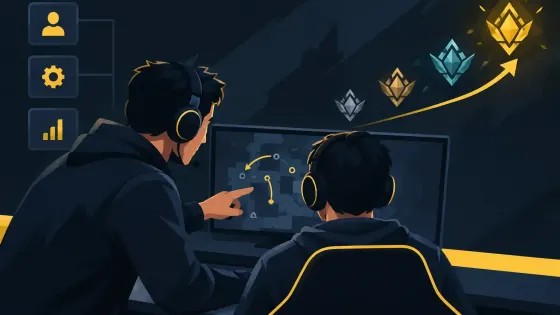

Coaching Versus Boosting: Which Fits Your Goal?
Coaching versus boosting comes down to your goal: learn faster or reach a target rank. Compare cost, time, account access, and risk before you choose.

In this article7 sections
A few wins from promotion can feel very different from a rank you cannot hold on your own. That is the real choice behind coaching versus boosting. One service helps you build the habits to play better yourself. The other helps you reach a defined result when time, schedule, or a difficult rank wall is the main problem.
Neither option is automatically better. The right pick depends on what you want from the next few weeks of ranked, how much you can play, and whether the result matters more than the learning process.
Coaching versus boosting: the basic difference
Boosting is a result-focused service. You choose a goal, such as a target rank, a number of net wins, placement matches, or a set number of games. A booster plays toward that goal, and you can follow the order progress and communicate in order chat. In a duo order where that option is available, you play alongside the booster instead of handing over the games completely.
Coaching is a skill-focused service. You play the games, while a coach helps you understand what is costing you wins. That can include one-on-one sessions, VOD feedback, Discord Q&A, a practice routine, and a climb plan built around your role, agents, champions, or common mistakes.
The simple version is this: boosting changes the account result; coaching changes the player. Sometimes players use both, but they solve different problems.
Choose boosting when the outcome matters most
Boosting makes sense when you have a clear, limited goal and little time to play through it yourself. Maybe you need to finish placements, recover a rank before the season ends, complete a set of competitive wins, or get through a stretch where work, school, or travel has cut your game time.
It can also fit players who have already reached a level before and do not want to grind every game back after a reset or a long break. In that case, the purchase is mostly about convenience. You are paying for games played toward a defined target, not for a lesson.
A properly configured order makes the outcome clear before checkout. Depending on the game, you can select your current rank and target rank, choose wins or games, select your server, and add available options. That makes it easier to compare the order with your actual goal instead of buying a vague promise.
Solo boosting and duo boosting are not the same experience. A solo boost is the hands-off option: the booster plays on the account. With duo boosting, you remain in the queue and play with the booster. Duo can be useful if you want to stay involved, see decisions happen in real matches, and avoid the adjustment of returning to an account that has moved ahead without you.
Not every game or service supports duo. For example, CS2 services do not have a duo option. Check the service setup for the game and goal you are ordering rather than assuming the same options apply everywhere.
Boosting has an obvious limit: it does not automatically improve your decision-making. If you return to ranked with the same habits, you may struggle in the new lobby level. That does not make a boost the wrong choice. It just means you should buy it for the right reason - progress toward a result, not a replacement for practice.
Choose coaching when you want to keep the rank
Coaching is better when the same problems keep showing up in your games. You may know you are losing, but not why. Perhaps your lane leads disappear after the mid game in League, your Valorant rounds fall apart after first contact, your CS2 utility has no purpose, or you keep taking fights in Apex that leave your squad with no reset.
A coach can spot patterns that are hard to see while you are playing. The value is not only in hearing that a play was bad. It is in understanding the trigger: poor timing, missing information, bad positioning, weak economy decisions, an unclear win condition, or a mechanical habit that breaks under pressure.
Good coaching should give you work you can use in the next session. That might mean a focused warm-up, a small champion or agent pool, a review checklist, better recall timings, a plan for round openings, or rules for when not to fight. The goal is not to overload you with theory. It is to remove the mistakes that repeatedly decide your games.
Coaching takes more effort than boosting because you need to apply the feedback. You will still lose some games while changing habits. Progress can be uneven, especially if you are learning a new role, character, or map. But the improvement stays with you across future seasons, placements, and queues.
If your main frustration is, “I do not know what I should fix,” coaching is usually the stronger starting point.
Reward boxes
Open a box, win real rewards
Spend N1 Coins to open a box and win coins, checkout discounts, or a free coaching/boost service.

Account access, privacy, and personal involvement
How involved you want to be matters as much as your rank goal. Coaching requires your time and attention. Duo boosting requires you to queue and play. Solo boosting requires the least involvement, but it means another player completes games on your account.
For solo orders, N1Boost uses the N1App desktop app so the booster signs in without seeing the customer's login. The login is encrypted and deleted when the order ends. Options such as Offline Chat and VPN can be selected where available. Boosters are ID-verified and play by hand, with no cheats, scripts, or bots.
These measures address account handling, but they do not remove the game policy issue. Boosting is against most games' terms of service, and no boosting method is risk-free. If that risk does not work for you, choose coaching or keep the climb entirely on your own account and in your own hands.
That trade-off is worth considering before you pay, not after the order starts. Be honest about your comfort level with account sharing, how quickly you need a result, and whether you want to be present for the games.
Cost is not just the checkout price
A boost has a direct, visible price based on the order setup. Coaching has a direct session cost, but its value depends on whether you use the feedback after the call ends. Neither is automatically cheaper in a meaningful sense.
If you only need a specific outcome once, boosting may be the more practical spend. If you plan to keep grinding ranked for months, coaching can provide more value because the lessons apply to every future match. A duo order sits in the middle: you are working toward rank progress while seeing a stronger player operate in your own games, though it is not a substitute for structured coaching.
Think about the cost of time, too. Grinding dozens of games while tired or tilted rarely produces your best learning. On the other hand, paying for a boost and then immediately queuing at a higher level without a plan can create a new kind of frustration.
When using both makes sense
There are cases where coaching and boosting work well together. A player might use coaching first to identify the biggest limits, then choose a duo service to stay involved in the climb. Another player may use a boost to reach a seasonal target and book coaching afterward to prepare for games at that rank.
The order matters. If your long-term goal is to become better, start with coaching. You will have a clearer idea of what rank is realistic, what to practice, and whether your issue is mechanics, knowledge, consistency, or simply not enough hours to play.
If your goal is strictly practical - placements completed, a target division reached, or a fixed number of wins - boosting may be enough. Set the target carefully. A smaller, defined order can be easier to evaluate than chasing a rank change without thinking about what comes after it.
Make the decision based on your next game
Ask one direct question: when you queue after this purchase, what do you want to be different? If the answer is “my account should be at a specific rank,” boosting fits the job. If the answer is “I want to understand why I lose these situations,” coaching is the better investment.
You can track a boost through order chat and get 24/7 support if you need help with an active order. With coaching, take notes, save the drills, and give the advice enough games to become a habit. The better choice is the one that matches the problem you actually have, not the one that sounds better in a rank conversation.
Ready to climb?
Pick a service, set your options and get matched with a verified booster. Secure checkout and 24/7 support.
- VPN and offline mode
- Verified boosters
- 24/7 support